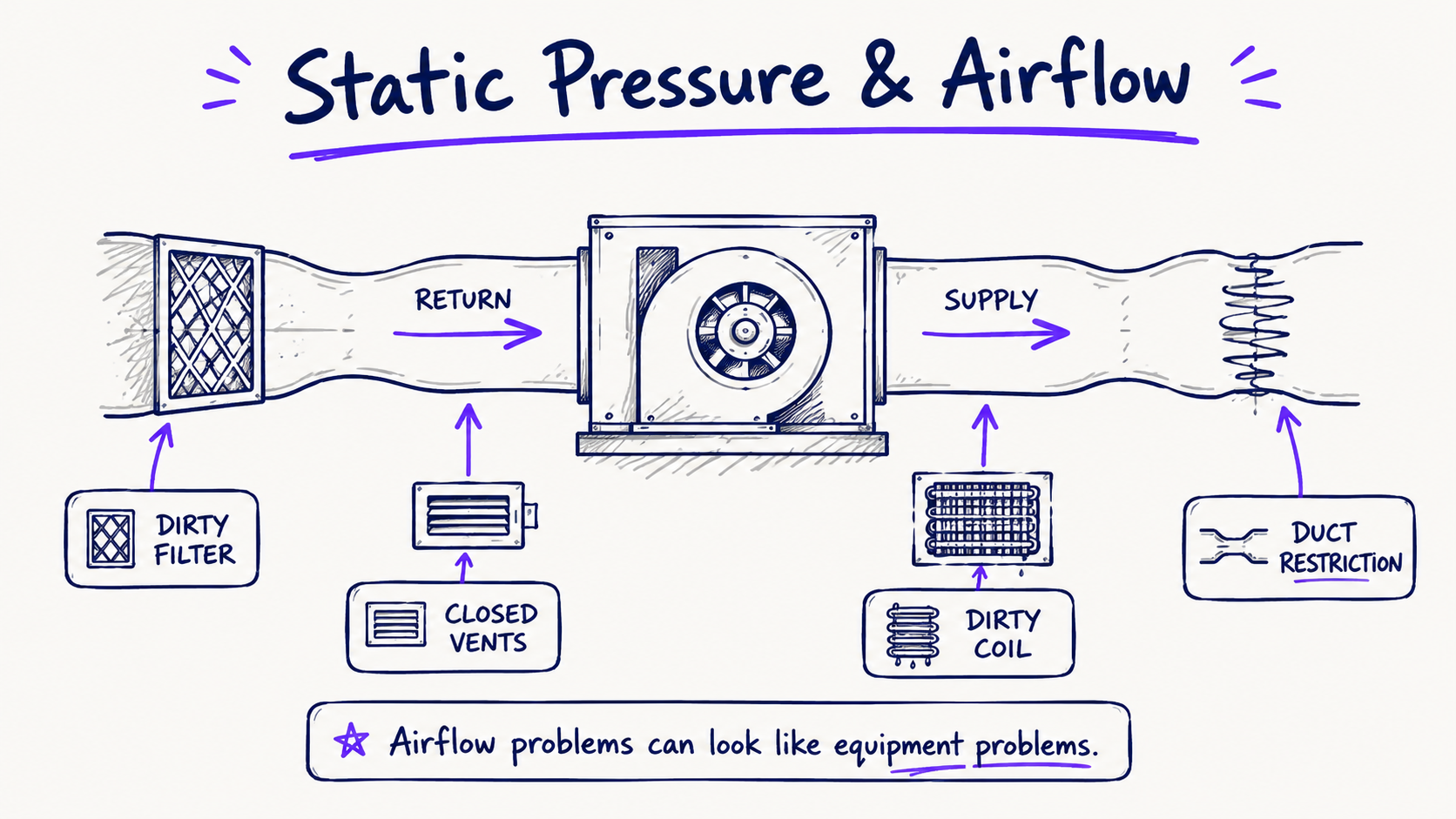
Static pressure sounds like an advanced HVAC term, but the basic idea is simple: it is the resistance your blower has to push and pull against to move air through the system.
Think of the HVAC system like a breathing system. The return side is the inhale. The supply side is the exhale. If the filter, coil, ducts, grilles, or vents restrict that breathing, the equipment may still run but the home may not cool or heat correctly.
That is why airflow problems fool people. A homeowner feels warm air or weak cooling and assumes the system needs refrigerant. Sometimes it does. But many comfort complaints start with air not moving the way it should.
What static pressure means in normal language
Your indoor blower is designed to move a certain amount of air. It has to pull air from the house through return grilles and a filter, move it across the indoor coil or heat exchanger, and push it back through the supply ducts.
Static pressure is the “pushback” against that airflow. Some resistance is normal. Too much resistance is a problem.
High static pressure can be caused by:
- Dirty or restrictive filters
- Undersized return ducts
- Blocked return grilles
- Dirty evaporator coils
- Crushed or kinked flex duct
- Closed or blocked supply vents
- Poorly designed duct transitions
- Too many dampers closed
- Supply ducts that are too small
- A blower speed or equipment mismatch
The result is often a system that sounds busy but does not make the house comfortable.
Why high static pressure matters
High static pressure can affect comfort, efficiency, noise, and equipment life.
Possible symptoms include:
- Weak airflow from vents
- Loud return grille noise
- Whistling filter slots
- Doors moving when the system starts
- Hot and cold rooms
- Long run times
- Short cycling
- Frozen evaporator coil in cooling mode
- Furnace limit trips in heating mode
- Higher energy use
- Blower motor stress
A system can have a clean outdoor unit and still perform poorly if the indoor airflow is restricted.
Homeowner checks that actually relate to airflow
You cannot measure static pressure accurately without the right tools, but you can look for clues.
Check the filter fit and condition
A filter can create problems in two ways: it can be dirty, or it can be too restrictive for the system. Replace dirty filters, but also make sure the replacement is the correct size and type.
Warning signs:
- The filter is bowed or sucked inward.
- The filter slot whistles.
- The filter gets dirty very quickly.
- The system sounds quieter when the filter is removed for a brief visual check.
- The home has a very high-MERV filter in a system not designed for it.
Do not leave the filter out as a fix. The point is to identify restriction, not run the system unfiltered.
Look at return grilles
A return grille should not be blocked by furniture, boxes, curtains, or dust buildup. If the home has only one central return and bedroom doors stay closed, the system may struggle to get enough return air.
Check supply vents
Make sure supply vents are open and not covered by rugs or furniture. Closing several vents to redirect air can raise static pressure and reduce total airflow. It may also make the blower work harder.
Walk the attic visually if it is safe
If the ductwork is accessible and the attic is safe to enter, look for obvious duct problems from a distance:
- Crushed flex duct
- Ducts disconnected from boxes or plenums
- Torn outer jacket or missing insulation
- Sharp bends or long sagging runs
- Air blowing into the attic
- Kinks near the air handler
Do not step through ceilings, disturb electrical wiring, or crawl into unsafe spaces.
Why a dirty coil can mimic other problems
The evaporator coil sits inside or near the air handler. Air has to pass through it. If the coil is dirty, matted, or blocked, it can restrict airflow and reduce heat transfer.
A dirty coil can contribute to:
- Weak cooling
- Frozen coil
- Longer run times
- Poor humidity control
- Water or drain problems
- Higher static pressure
This is why filter maintenance matters. A filter is not just about dust in the house. It helps protect the coil and blower.
Why duct design matters more than people think
Ductwork is not just a set of tubes. It is part of the HVAC system. If the ducts are undersized, poorly routed, crushed, leaky, or badly connected, the equipment may never perform the way the rating label says it should.
In Texas homes with attic ductwork, duct problems can be magnified because the attic is hot. A supply duct leaking cold air into a 130°F attic is not a small issue. A return duct pulling attic air into the system can make cooling and indoor air quality worse.
What a technician measures
A technician can measure static pressure using test ports and a manometer. The measurement helps show whether the blower is operating against too much resistance. Static pressure is usually evaluated with manufacturer blower data, equipment setup, filter type, coil condition, and duct design.
A technician may also evaluate:
- Total external static pressure
- Pressure drop across the filter
- Pressure drop across the coil
- Blower speed settings
- Delivered airflow
- Duct leakage
- Temperature split
- Refrigerant performance after airflow is verified
That last point matters: refrigerant readings can be misleading if airflow is wrong. Good diagnosis usually checks airflow before jumping to refrigerant conclusions.
Static pressure and comfort complaints
Here are a few ways high static pressure can show up in real life:
“The AC runs all day but the house is still warm”
The system may not be moving enough air across the coil, or it may be losing cooled air through ducts.
“The living room is fine, but the bedrooms are hot”
This may involve duct sizing, balancing, return-air paths, attic heat, or insulation. It is not always the outdoor unit.
“The return grille is loud”
A loud return can mean the system is trying to pull too much air through too small an opening.
“The filter gets sucked in”
That can indicate the blower is pulling hard against a restrictive filter or return setup.
“The coil froze”
Freezing can involve low refrigerant, but airflow restriction is also a common cause. The filter, blower, coil, and duct system all matter.
Why this is not a DIY repair article
It is useful for homeowners to understand static pressure, but measuring and correcting it is not usually a DIY job. Fixes may involve duct resizing, return additions, blower settings, coil cleaning, balancing, or equipment setup. Those changes affect system safety and performance.
What you can do is collect better information: filter condition, vent airflow patterns, noisy returns, room temperature differences, and visible duct issues. That information makes the service call more productive.
FAQ
What is HVAC static pressure?
HVAC static pressure is the resistance to airflow in the duct system and indoor equipment. Too much resistance makes it harder for the blower to move the right amount of air.
What are symptoms of high static pressure?
Common symptoms include weak airflow, loud returns, whistling filters, hot and cold rooms, long run times, frozen coils, furnace limit trips, and blower motor stress.
Can a dirty filter cause high static pressure?
Yes. A dirty or overly restrictive filter can increase resistance and reduce airflow.
Can closing vents hurt the HVAC system?
Closing a few vents briefly is usually not catastrophic, but closing many vents can increase static pressure, reduce airflow, and create comfort or equipment problems.
Should static pressure be checked before refrigerant?
Often, yes. Airflow problems can affect refrigerant readings and cooling performance. A good diagnosis usually verifies airflow rather than assuming refrigerant is the first issue.
Related guides
- AC Not Blowing Cold Air? Start With These Safe Checks
- Attic Ductwork: What to Check Before You Blame the Equipment
- Inside Your Air Handler: The Parts Homeowners Should Recognize
- Is Air Duct Cleaning Worth It? A Straight Answer
Sources worth reading
- ENERGY STAR HVAC maintenance checklist: https://www.energystar.gov/campaign/heating_cooling/maintenance_checklist
- ACCA homeowner resources: https://www.acca.org/homeowners
- U.S. Department of Energy ducts and air sealing: https://www.energy.gov/energysaver/ducts-and-air-sealing
WHEN TO REQUEST SERVICE
Need help with this issue in Ferris or nearby Ellis County?
Submit a request and we will review it for local follow-up. Include what the system is doing, when it started, and anything you have already checked.